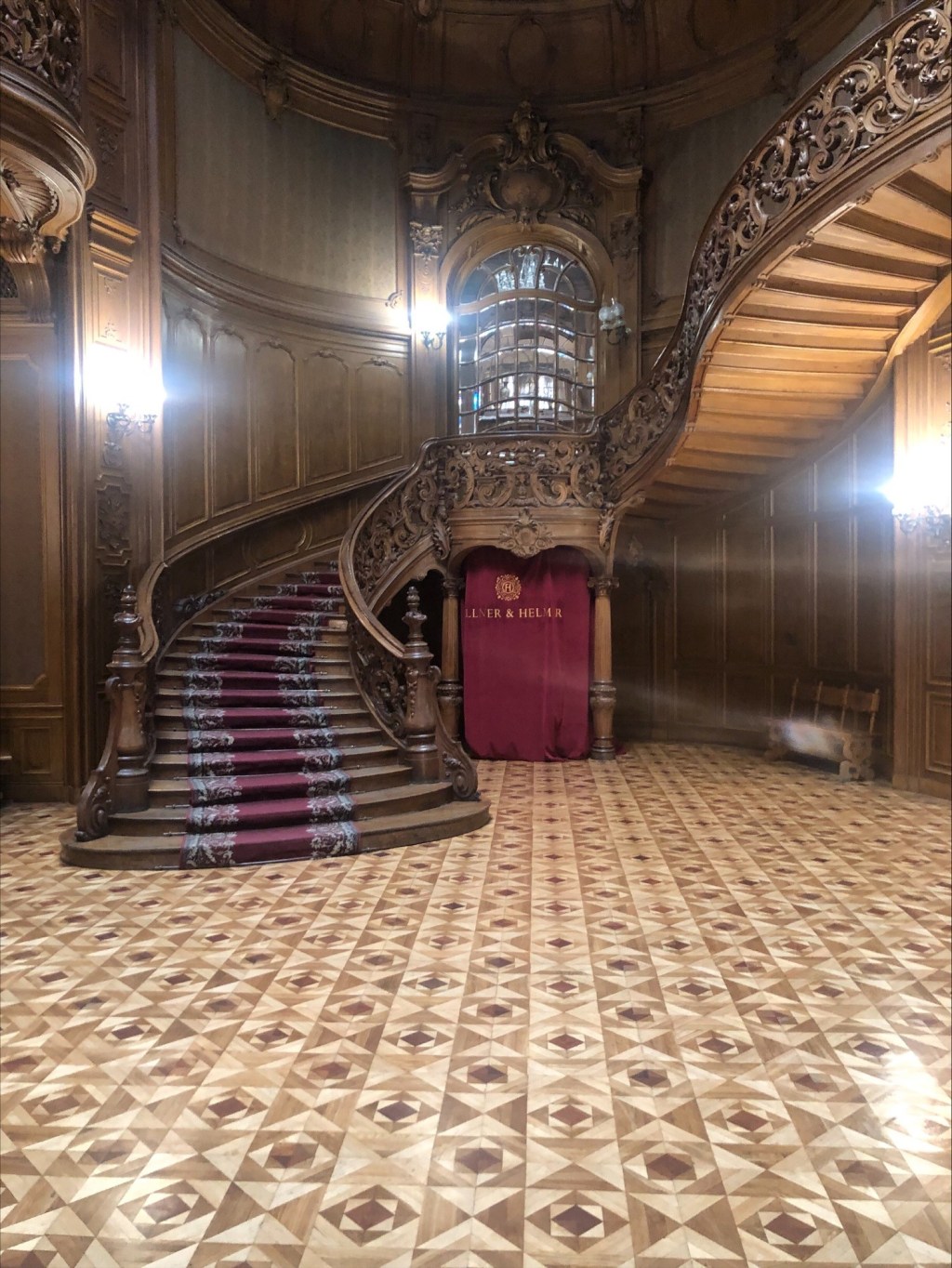
Friday morning, we visited the rather splendid Lviv office of the Trade Union of Education and Science Workers of Ukraine. The office is in the House of Scientists, a stunning neo-baroque building that used to be a casino for the rich elite of Lviv.
The union was established on 14 September 1990, as the successor to the Ukrainian section of the Education, Higher Schools and Scientific Institutions Workers’ Union of the USSR. It has over 100,000 members and represents workers at all levels of education.
We met with the regional union leader Maria, together with the deputy leader, organiser / second deputy, and head of finance. They will publish a report of our meeting on their social media.
They began by telling us that they are grateful for our support of Ukrainian education workers during the war: “All regions of the union are grateful for your solidarity – what you are doing is very powerful.” They added that, “In the hard times of war, a lot of people suffer and need help – but we are united.”
Education workers in the occupied territories
We began by asking about the situation of education workers in the parts of Ukraine that are occupied by Russia. It is “very hard and complicated”. Russia forces them to get Russian citizenship and Russian passports even though they don’t want to: it’s a matter of life and death.
They have to teach the Russian curriculum, in Russian, as part of a cultural offensive to assert a Russian identity in the area. Russian teachers have been sent to the occupied territories.
Some of the children in the occupied Ukrainian territories have been taken to Russia, with their parents told that they were going to a ‘summer camp’. The parents and the Ukrainian government are trying to get the children back.
Trade union rights in a country at war
The trade union faces the challenge of wartime conditions – supporting national self-defence while continuing to organise for workers’ rights.
The municipal authority has been trying to remove financial independence from the union, although the union has won the first stage of its battle against this.
The government has been attacking union rights since 2022, restricting their right to hold protests for justice for workers. But as Maria asserts, “The role of our trade union is to stand up for our workers.”
Lots of education workers volunteer to help with the war effort.
The Lviv region is relatively safe, although there has been an increase in rocket attacks over the last month. Other regions, closer to the fighting, are dangerous.
When air raid sirens sound, students and workers go to shelters, day or night. The alarms are mostly at night. In the more dangerous parts of the country, education workers work online. Some universities have relocated to Lviv.
Calling for better pay
Teachers’ wages are not high, averaging 350 euros per month.
The union has been writing to the government calling for a pay rise. It has been lobbying members of the country’s parliament, and speaking publicly to articulate the needs of education workers and call for support for them.
Having had no pay rise this year, they are campaigning for a rise in 2025.
The union says that “It is understandable that most financial resources are going to the army, but education workers’ role is important too.”
The union’s 41 local districts are contacting their local representatives in villages and towns to involve them in this campaign.
How the union runs
We asked how the union runs, and heard that it operates in each school, and on territorial and regional levels.
The union believes that all workers know how to contact and get involved in the union, although this was not borne out when we asked kindergarten and school workers about the union’s presence in their workplace and their awareness of the union’s campaigns and activities.
Helping union members affected by war
The union told us that “In harsh times of war, we still help our members. We help members whose family members have gone to war or been killed.”
When full-scale war started, when Russia invaded, students and education workers came to Lviv from the dangerous areas. Local people hosted them, provided food etc.
The union supports education workers who voluntarily joined the armed forces. It has a support fund for these workers and for the families of those who have been injured or killed, including paying for funerals.
Rehabilitation centre
The union has established a Centre for Social and Psychological Rehabilitation to increase the provision of support they can provide to their members.
Currently the union can provide accommodation for a small number of people in their office building, but sometimes double the number of people are trying to be accommodated in the space they have available.
The union has taken the initiative to build as part of a partnership with its sister union in Poland and with international charities a purpose built centre to provide rehabilitation and recreation, and operate as a sanitorium and retreat. It’s main aim for teachers suffering trauma and mental health issues because of the current hostilities but to continue as a resource into the future. It has six treatment rooms and sixty beds.
The building is complete, but it lacks furniture and equipment. We are considering how we can raise funds to help complete this important project and get this invaluable resource up and running.
Trade union education
We asked about how the union educates its representatives and activists.
The union’s organiser explained that it runs an education programme for activists based mostly on sharing experiences between different regions. This played a very important role before the invasion and still operates, but travel is more difficult.
The main aim of the union’s education programme is its local base. There are 1,500 union bodies in the region. The union holds seminars every two months, and activists themselves suggest the topics. So far, this has included issues such as the law – understanding it and explaining it to workers; negotiating; and practical skills such as how to run a members’ meeting, how to write documents, and so on.
Union leaders travel abroad to educate trade union activists in other countries about the situation in Ukraine.
We asked about education and training on issues such as health and safety and equalities. The union told us that health is a very important issue for them. Workers need health certificates, which the government is supposed to pay for. If the government tries to make workers pay, the union objects.
Disabled workers
We asked how the union is preparing for the needs of the influx of disabled education workers for after the war. The union replied that it is raising the demand for psychology services for war trauma and for refugees, and wants to see lifts and accessibility measures in schools and at all levels of education. They acknowledge that this is common at university level and at some schools but is an important area where there needs to be a lot of work done, both physically changing the designs of building to make them accessible but also to adapting the curriculum as well.
The union is already supporting and representing war-injured staff already working in schools. Again they referenced their rehabilitation centre as one example of work the union is undertaking to support teachers to stay in employment.


 Leicestershire NEU
Leave a comment